

Why Foliage Alone Is Enough: Can You Design a Beautiful Garden Without Flowers?

Updated: Aug 30
Design Thinking - Part 10
By Ian Green, Pre-Registered Member of the Society of Garden & Landscape Designers

Ask most people to describe their dream garden and they'll reach for colour first - roses, dahlias, a border bursting with pinks and purples, it's an understandable instinct. But can a garden be beautiful without flowers? Absolutely. In fact, some of the most striking gardens I design rely almost entirely on foliage.
By using different shades of green, contrasting leaf shapes and strong evergreen structure, it's possible to create a garden that's calm, architectural and attractive throughout the year - not just when flowers are in bloom. Crucially, it doesn't disappear the moment summer ends. Flowers provide moments of seasonal excitement. Foliage provides the structure that allows those moments to shine
Many people assume that if a border isn't full of flowers, it will feel empty. That's understandable. Garden centres, magazines and television often celebrate colour above everything else. But after twenty-five years designing gardens, I've found that lasting beauty usually comes from structure first and flowers second.
Here's why I so often build my planting schemes around foliage first and let flowers earn their place as the supporting cast rather than the headline act.
In this article you'll discover:
Why foliage creates year-round interest
How I use foliage to create structure and year-round interest
The best foliage plants for sun and shade
How to build a low-maintenance planting scheme
Why flowers work best as highlights rather than the main attraction
1. Green Is Not One Colour - It's Dozens
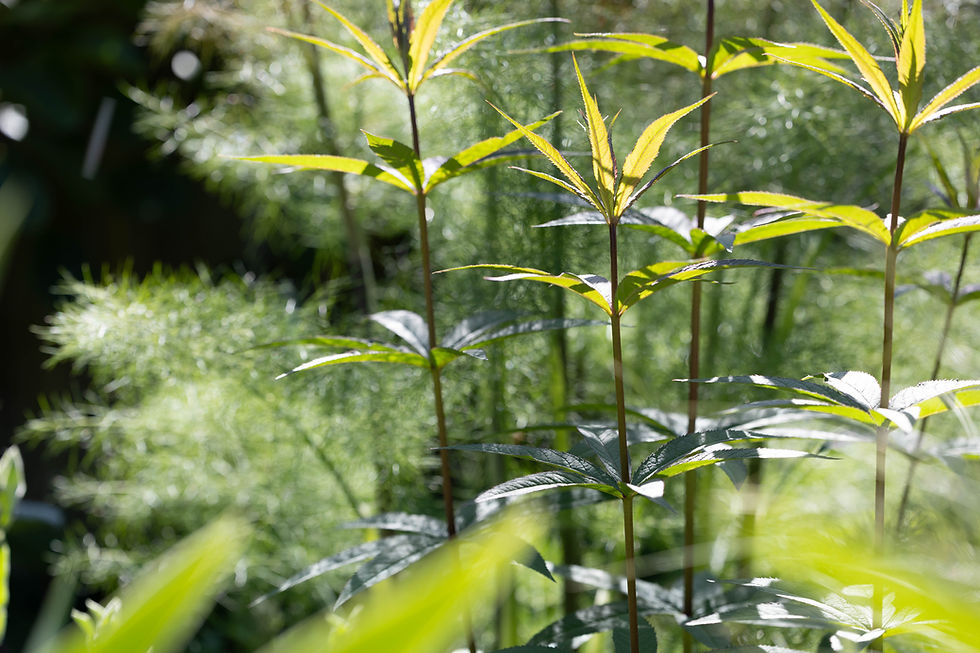
The biggest misconception about a foliage-led garden is that it will look flat or monotonous. In reality “green” covers an extraordinary range - the acid-lime of a young Hakonechloa, the deep near-black of Ophiopogon, the silvery-blue of Eucalyptus, the glossy emerald of Fatsia japonica. Placed side by side, these tones do exactly what a flower border does: they create contrast, depth, and rhythm.
There's also a genuine psychological benefit here. Green sits at the centre of the visible spectrum, and it's widely recognised as one of the most restful colours to the human eye, which is precisely why hospitals, spas, and meditation gardens lean so heavily on it. A garden built from layered greens has a calm, settled quality that a riot of flower colour can actually work against. If you want a garden that feels like an exhale rather than an exclamation mark, foliage is where you start.
A tip from the drawing board: Don't just think light and dark green - hunt out variegation, blue-greys, bronzes and near-blacks too. A border with five or six distinct foliage tones reads as richly as any flower bed, and it holds that richness for months, not weeks. |
2. Leaf Shape Brings the Drama (and the Tropics)

Colour is only half the story, shape is where foliage really earns its keep. A spiky Phormium next to the rounded pads of Bergenia, next to the deeply cut fronds of a tree fern, creates the kind of visual tension that a bed of uniform, rounded flower heads simply can't match.
This is also how you achieve that sought-after “jungle” or tropical look without a greenhouse full of tender exotics. Big, bold, architectural leaves - think Fatsia, Tetrapanax, or hardy palms such as Trachycarpus Fortunei - instantly signal drama and abundance. Pair large leaves with fine, feathery textures (grasses, ferns) and you get the layered, immersive feeling of a rainforest floor, built almost entirely from hardy, low-maintenance plants.
Shape does something flowers rarely can: it changes how a space feels to move through. Strappy, upright leaves draw the eye up and make a border feel taller and more dynamic. Broad, horizontal leaves slow the eye down and add calm. A good foliage scheme choreographs both.
3. Year-Round Interest - The Real Reason Foliage Wins

This is, for me, the single biggest argument for a green-led garden: leaves don't clock off in October.
A traditional flower border can look genuinely spectacular for six to ten weeks a year, and fairly unremarkable for the rest of it. Evergreen and structural foliage, by contrast, is doing its job in January just as much as July. Add a few plants with strong autumn leaf colour or interesting winter seed heads, and you have a garden that never has an “off season.”
This matters even more if you're only in the garden at certain times of year, or if the garden is visible from indoors through the darker months, when a bare, flowerless border can feel like the least appealing view in the house. For more information on creating a garden with all year-round interest, have a look at my journal Transform Your Outdoor Space: The Importance of Year-Round Garden Design.
4. Flowers Are Brilliant, But They're Time-Limited
I want to be clear: I'm not anti-flower. Flowers bring pollinators, seasonal excitement, and moments of real joy to a garden. However, one of the biggest misconceptions in garden design is that flowers create beautiful gardens. They don't. They enhance beautiful gardens. The real work is done by structure, proportion and planting that holds everything together once the flowers have faded.

Most herbaceous flowering plants have a bloom window measured in weeks. Once that window closes, you're often left looking at fading petals, cut-back stems, or bare soil until next year. A garden designed entirely around flowering moments can therefore feel like a series of short performances separated by long intervals.
Foliage doesn't have that problem. It's the reliable, load-bearing structure that a garden can lean on all year, and it's exactly why, as I set out in my guide to Right Plant, Right Place, choosing plants that will genuinely thrive in your garden's conditions matters more than chasing a colour palette. A well-placed foliage plant will still be earning its spot in five years. A poorly placed flowering plant may have already been dug up and replaced twice.
My approach is generally: build the garden's structure and year-round interest from foliage, then use flowers as seasonal punctuation - not the entire sentence.
A Real Project Example
One client came to me wanting colour throughout the year, but was frustrated that their borders looked tired every winter. Rather than chasing a succession of flowers, we built the planting around evergreen structure, contrasting foliage and layered textures. The result was a garden that felt full and settled in every season, with flowers becoming moments of emphasis rather than the whole display. Several years later, the flowers still come and go, but the garden never feels empty. You can see this approach in practice in my Client Garden Transformation case study.
5 Plants I Recommend for a Foliage-First Garden
• Fatsia japonica - Huge, glossy, hand-shaped evergreen leaves that instantly bring architectural drama and a tropical feel. Thrives in shade, making it invaluable for the trickier corners of a garden.
• Heuchera (Coral Bells) - Available in shades from lime-green to near-black and deep purple, Heuchera forms low, colourful mounds that hold their colour through most of the year with almost no maintenance.
• Phormium (New Zealand Flax) - Bold, upright, strap-like leaves in green, bronze or striped variegation. A single specimen can act as a focal point that a whole flower bed would struggle to match.
• Hakonechloa macra (Japanese Forest Grass) - Soft, cascading, acid-green foliage that moves beautifully in the wind and works brilliantly as textural contrast against broader leaves.
• Ophiopogon planiscapus 'Nigrescens' (Black Mondo Grass) - Striking near-black, grass-like foliage that adds depth and drama when planted alongside silver or lime-green companions.
Frequently Asked Questions
What is a foliage garden?
A foliage garden is designed around the shape, texture and colour of leaves rather than relying on flowers for impact. That doesn't necessarily mean there are no flowers at all, but the structure of the garden comes from carefully chosen foliage plants, evergreens and ornamental grasses. The result is a garden that feels calm, layered and attractive throughout the year, rather than only during a short flowering season.
Will a garden without flowers look boring?
Not if it's designed with variety in mind. The key is contrast - in colour (lime green against near-black, silver against deep emerald), in shape (broad leaves against fine grasses), and in texture (glossy against matte). A well-planned foliage garden has just as much visual interest as a flower border, and it holds that interest for far longer.
Can I still have some flowers in a foliage-led garden?
Absolutely, and I'd usually recommend it. Think of flowers as seasonal highlights layered over a foliage structure, rather than the other way around. A handful of well-chosen flowering plants scattered through a foliage backbone can bring pollinators and seasonal colour without leaving the garden looking bare once they've finished.
Which evergreen plants provide year-round interest?
Evergreens are the backbone of many of my planting schemes because they give a garden structure in every season. Plants such as Fatsia japonica, Sarcococca, Skimmia, evergreen ferns, Pittosporum and many ornamental grasses continue to provide colour, texture and form long after flowering plants have faded.
Choosing the right evergreen plants for your garden's conditions is far more important than simply choosing the most eye-catching variety. If you'd like to explore this in more detail, I've covered it in my guide to Right Plant, Right Place.
What are the best foliage plants for shade?
Some of the most beautiful foliage plants actually thrive in shade. Favourites I regularly recommend include Fatsia japonica, Hakonechloa macra (Japanese Forest Grass), ferns, Hosta, Heuchera, Brunnera and Ophiopogon (Black Mondo Grass). Combining different leaf sizes, colours and textures can turn even a difficult shady corner into one of the most interesting parts of the garden.
Can a foliage-only garden still feel tropical?
Yes - and this is one of the most popular looks I design. Large, bold leaves (Fatsia, Tetrapanax, hardy palms such as Trachycarpus fortunei) combined with layered planting and lush ground cover create a genuinely jungle-like feel using entirely hardy, UK-suited plants.
Are foliage gardens lower maintenance?
Generally, yes. Many foliage plants, particularly evergreens, need less deadheading, staking, and seasonal replacement than flowering perennials and annuals. That said, the same rule from my guide to Right Plant, Right Place still applies: choose the wrong plant for your light, soil, or space, and even the toughest foliage plant will struggle.
How do I add colour without flowers?
Colour in a garden doesn't have to come from blooms. Foliage offers an incredible range of greens, from bright lime through to deep emerald, silver, blue-grey, bronze and almost black. Add in coloured stems, textured bark and seasonal autumn foliage, and you can create a rich, visually interesting garden without relying on flowers alone. It's often these quieter contrasts that give a garden its sense of depth and lasting appeal.
Can a foliage garden support wildlife?
Absolutely. A foliage-led garden can be just as valuable for wildlife as a flower-filled border when it's designed thoughtfully. Layered planting provides shelter for birds and insects, evergreen shrubs offer year-round habitat, and carefully selected flowering plants can still be included to provide nectar for pollinators. Good garden design is about creating balance, not choosing one approach over another.
A Final Thought
Flowers deserve their place. They bring movement, wildlife and moments of excitement. But they don't have to carry the whole garden. When the planting is built around good structure, texture and evergreen interest, flowers become something even better: seasonal highlights in a garden that already works beautifully every day of the year.
Struggling to know where to start with your garden? Designing a planting scheme that works all year round, not just for six weeks in summer, is exactly what I do. If you'd like a garden that looks considered, calm and full of interest in every season, I'd love to help you plan it. Click here to get in touch to discuss your garden design |
About the author Ian Green is a garden and landscape designer with over 25 years’ experience, working with clients across Lincolnshire, East Midlands and beyond. He believes that the best gardens start with listening to the space, and to the people who’ll live in it.


Comments